Struggling with complex problems or technical conflicts? Finding brainstorming sessions ineffective at generating valuable ideas? Desiring to impress your customers, colleagues, or superiors with unexpected, game-changing solutions? If you answered yes to any of these, TRIZ is your answer.
Understanding TRIZ
TRIZ, an acronym for Theory of Inventive Problem Solving, is a brainchild of the late 1940s. Genrich Altshuller, a gifted Soviet engineer, after analyzing a pool of 100,000 patents, founded this methodology. Altshuller realized that the evolution of systems followed certain identifiable patterns. Harnessing these patterns, coupled with a tailored algorithm, can exponentially speed up the innovation process!
Benefits of TRIZ
Implementing TRIZ in your problem-solving efforts can help you:
- Generate extraordinary, ‘out-of-the-box’ solutions, setting you apart from the crowd.
- Boost personal satisfaction and career growth through noticeable contributions.
- Surprise your customers, both external and internal, with ‘WOW’ solutions, thereby creating a competitive edge.
- Save time and bypass frustration by systematically steering towards an ideal result, instead of aimlessly chasing the perfect solution.
- Transform hidden, detrimental, or unwanted elements of a system or process into beneficial resources, thereby minimizing trial and error.
The TRIZ Mechanism
If you’re a software engineer, you’re already acquainted with the core concept of TRIZ: it operates similarly to Design Patterns in software – offering general, reusable solutions to recurring issues.
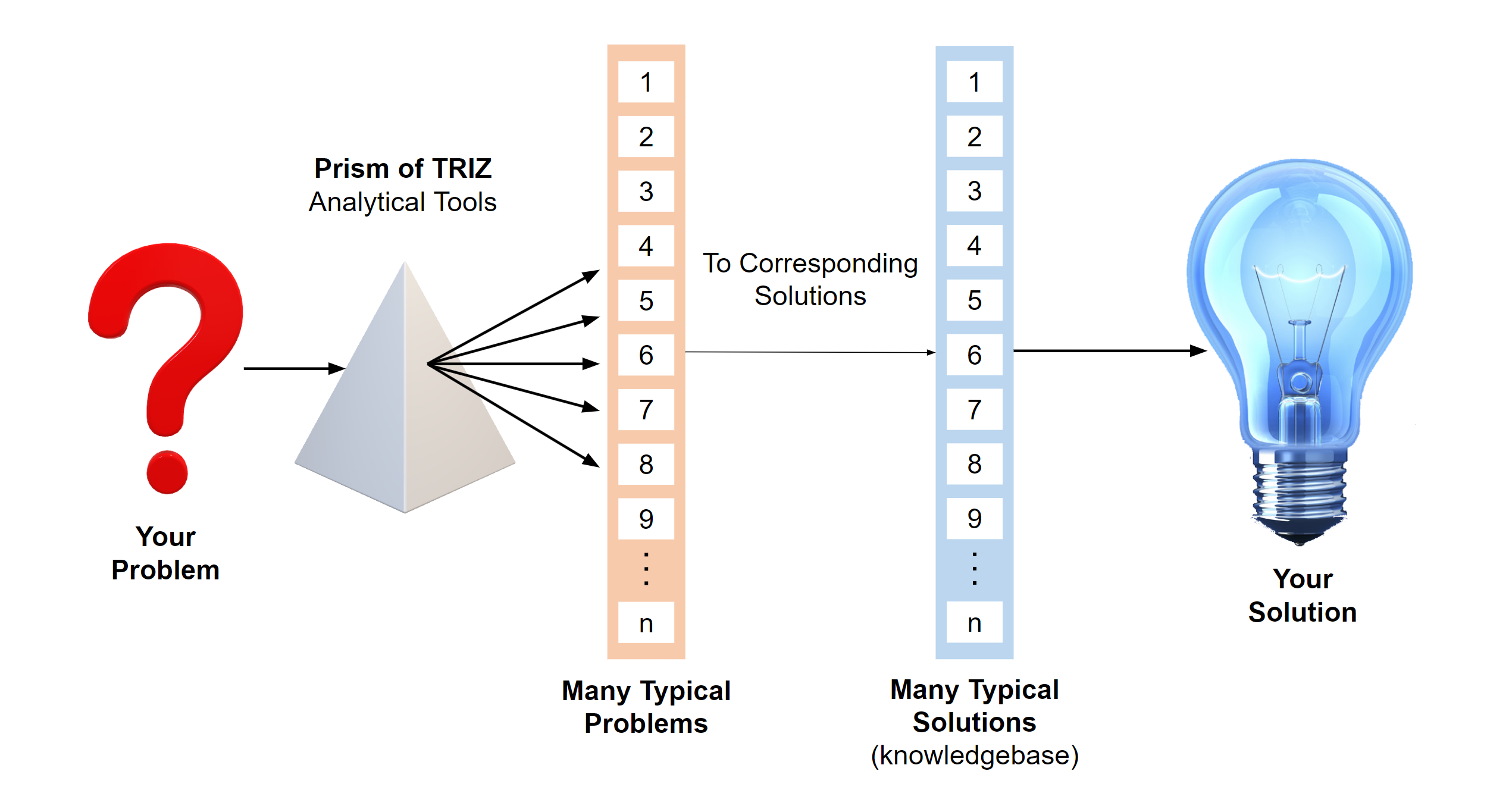
Here’s how it works:
- Begin by framing your problem.
- Examine the problem through the lens of TRIZ’s analytical tools.
- Relate your problem to a standardized or generic issue that has been previously solved.
- Identify a generic solution strategy or principle (out of the 40 principles that TRIZ provides).
- Draw from the generic solution to devise a unique resolution for your specific problem.
To illustrate this, let’s consider a common scenario in financial or commercial web applications with payments:

The teams face a conflict: one team is focused on safeguarding the web application from fraud, while the product team is concerned about not compromising the customer experience.
In such situations, teams often defend their positions instead of their interests. They get embroiled in brainstorming sessions, trying to address several competing requirements or, in simpler terms, contradictions. Dominant members, backed by specific experiences, can easily lead the conversation astray, introducing bias into the process. Consequently, the team may find themselves stuck in a rut, frustrated by the waste of time. The quest for “win-win” solutions begins, which often leads to compromises. While these trade-offs might seem small, they leave everyone less than fully satisfied. There has to be a better way, and that’s where TRIZ comes in:
| Step 1 Begin by framing your problem. | How to protect our web application without negatively impacting customer experience? |
| Step 2 Examine the problem through the lens of TRIZ’s analytical tools. Ask yourself:What are we trying to improve in the system or process?What is becoming worse when we improve something in the previous question?What happens before the process we trying to improve? In this case, before customers click the “Pay” button.What happens after the process we trying to improve? In this case, after customers click the “Pay” button. | The primary objective of the Fraud Team is to enhance the security features of the web application.Conversely, the application’s responsiveness deteriorates following the selection of the “Pay” button by customers. The goal of the Product Team is to boost, or at the very least, maintain the current level of responsiveness.Customers review their orders and input their payment information prior to selecting the “Pay” button.Customers are then directed to the payment confirmation page. However, if the payment processing is sluggish, it could potentially lead to customers abandoning the transaction and discontinuing the use of our web application. |
| Step 3 Relate your problem to a standardized or generic issue that has been previously solved. | Our generic problem is how to resolve a contradiction between security and speed. |
| Step 4 Identify a generic solution strategy or principle (out of the 40 principles that TRIZ provides). | One of the strategies in TRIZ is “Preliminary Action.” It means performing some steps before they are required orcurrently done. |
| Step 5 Draw from the generic solution to devise a unique resolution for your specific problem. | We can strategically initiate the detailed fraud evaluation process while customers are reviewing their orders or entering their payment details, prior to them clicking the “Pay” button. Consequently, by the time they proceed with payment, we would already have a fraud assessment score at our disposal to aid decision-making. Voila! In doing so, we’ve smartly utilized an overlooked resource – the time customers spend reviewing orders and inputting payment details – for our advantage, thereby reconciling the contradiction without any compromise. This approach caters to the interests of both teams at a minimal cost and without causing any negative or undesired effects. Indeed, a true win-win situation! |
You’ve just observed how TRIZ successfully redirected the conversation from “defending two contrasting and competitive team stances” to “identifying and addressing mutual interests” without any compromises, escalations, and at the least cost by capitalizing on “hidden” and existing resources within the system. This outcome is referred to as the Ideal Final Result (IFR) in TRIZ.
The Ideal Final Result, or a perfect system in TRIZ, is when we deliver all the advantages that the customer desires, at the lowest possible cost, with minimal negative impacts:

Final Thoughts
Undeniably, artificial intelligence platforms such as ChatGPT, GitHub Copilot, Bard, and others will redefine and eventually supplant numerous job roles. However, they cannot substitute the uniquely human capabilities of systems thinking, critical analysis, creativity, and problem-solving skills. As such, methodologies and frameworks like TRIZ will increasingly become indispensable.
The power of TRIZ lies not just in its ability to solve complex problems, but in how it reshapes our approach to problem-solving altogether. It pushes us to shift our perspective from a problem-focused view to a solution-oriented one, and from defending conflicting positions to exploring common interests.
Through the lens of TRIZ, we discover that even within challenging situations, there are hidden resources and opportunities that can be leveraged. It encourages us to redefine how we perceive conflicts and pushes us to look beyond the obvious for novel, yet efficient solutions.
In the case of our web application, the Ideal Final Result was achieved not by introducing a new element or compromising on any of the team’s interests, but by creatively employing an existing, often overlooked resource. This highlights the essence of TRIZ: driving innovation and problem-solving in a way that is both economical and efficient.
The journey toward the Ideal Final Result may not always be straightforward. It often demands lateral thinking, a shift in perspectives, and a willingness to challenge established norms. However, with TRIZ guiding the way, we can turn even the most complex problems into opportunities for innovation.
And last, but not least – TRIZ is more than just a problem-solving methodology. It’s a mindset that inspires us to think differently, challenges us to innovate, and empowers us to deliver optimal solutions that satisfy everyone involved. By practicing and promoting this approach, we can continually elevate our problem-solving skills, enhance customer satisfaction, and drive meaningful progress.
Resources
Intrigued by the potential of TRIZ? Eager to expand your knowledge and apply these techniques to your own work?
Dive into the resources I’ve curated below to begin your journey toward mastering TRIZ:
 Michael Kalika's Blog