Are you looking to take your problem-solving skills to the next level and deliver innovative solutions that not only work well, but also delight your users? Are you looking for ways to increase your scope at work and find interesting problems to solve? Then it’s time to learn and practice design thinking!
Design thinking is a powerful problem-solving approach that has been used by some of the world’s most successful companies, including Apple, Google, Intuit and IBM. At its core, design thinking is all about putting yourself in the shoes of your users, understanding their needs, and designing solutions that meet those needs in a simple and elegant way.
You are already skilled at writing efficient and effective code. However, design thinking can help you take your skills to the next level by incorporating user-centered design principles into your work. By doing so, you can create software that not only works well, but also meets the needs and expectations of your users.
But that’s not all. Learning and practicing design thinking can also help you:
Collaborate better with customers and XFNs by speaking their language and understanding their perspective.
Identify and prioritize the most important problems to solve, rather than just focusing on technical challenges.
Develop a more creative and innovative mindset, which can help you come up with unique solutions to complex problems.
Iterate quickly and efficiently, reducing the time it takes to get your software into the hands of users
Improve the overall user experience of your software, leading to increased customer satisfaction and loyalty.
So if you’re ready to take your software engineering skills to the next level, it’s time to start learning and practicing design thinking. The benefits are clear, and the results can be truly transformative for both you and your users. Let’s get started!
What does the design thinking process look like?
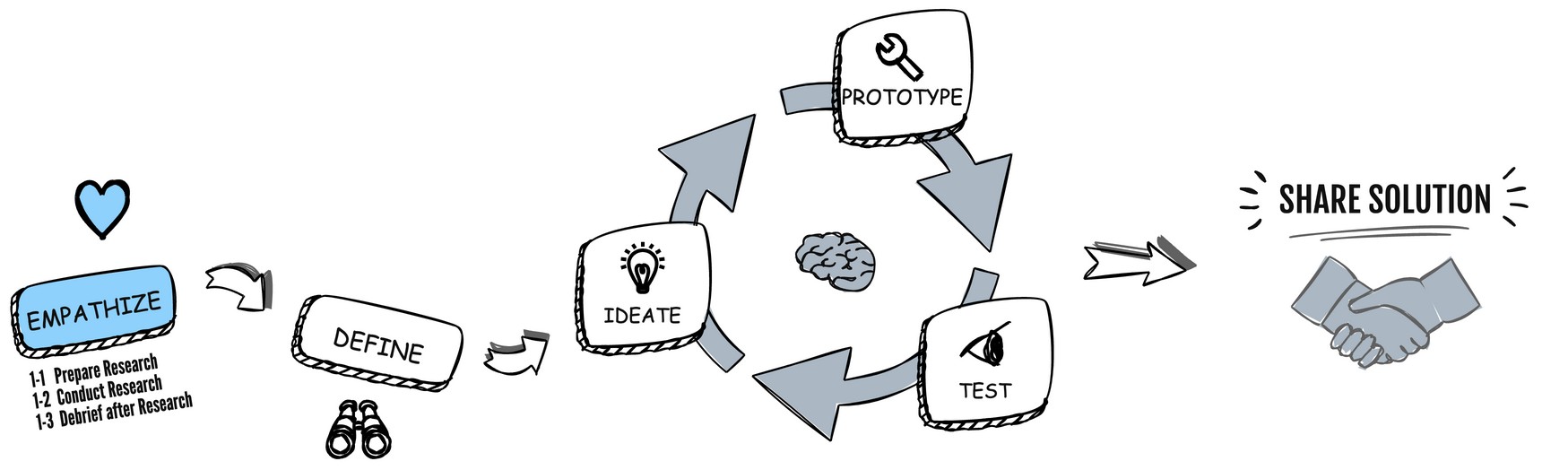
Design thinking consists of several iterative stages. Although the exact steps may vary depending on the specific methodology or framework used, the general design thinking process typically includes the following stages:

The design thinking process is not necessarily linear. It often involves iterating between the stages multiple times as you refine your understanding of the problem and develop suitable prototypes. This iterative approach allows you to test and refine your solutions until you arrive at a final product that meets the needs of your users and delivers value.
In these series of posts, I’ll explore how to apply design thinking for customer driven innovation. Ready to embark on this learning journey? Let’s get started!
Stage 1 – Empathize
What is it?
The empathize stage is the first stage of the design thinking process, and it’s all about gaining a deep understanding of the needs, goals, and challenges of your users. This stage is critical because it helps you to establish empathy with your users and develop insights that will inform the rest of the design process.
What are the inputs?
The inputs for the empathize stage include a range of data sources such as:
- Data and analytics
- User interviews and surveys
- Feedback and complaints from users
- Observational research
- Market research and competitor analysis
What are the outcomes?
The outcomes of the empathize stage include:
- A deep understanding of your users’ needs, goals, and challenges
- Empathy for your users’ perspective and experiences
- Insights into the emotional and social factors that influence user behavior
What are the tools and techniques to use?
Some of the most common tools and techniques used in the empathize stage include:
This is the most important and powerful technique (along with data and analytics). When I joined Intuit as an architect in 2017, I was introduced to an important technique called “Follow-Me-Home”. It also reminded me of “Genchi Genbutsu” which was practiced at Hewlett-Packard especially during automation of complex manufacturing lines of digital presses and their consumable products. We literally went to manufacturing plants to see how the products and parts are assembled, integrated and packaged.
- Observation, Customer Follow-Me-Home or Genchi Genbutsu (go and see [for yourself] in Japanese): This involves observing and interacting with users in their natural environment to gain insights into their behavior and experiences.
- Data and analytics: These tools help to analyze user and system behavior for identifying patterns and trends.
- User interviews and surveys: These tools help to gather direct feedback from users about their needs, challenges, and preferences.
- User personas and user journeys: These tools help to create a detailed picture of your users and their experiences with your product or service.
- Empathy mapping: This tool helps to identify the emotional and social factors that influence user behavior and decision-making.
Observation, Customer Follow-Me-Home or Genchi Genbutsu
The “customer follow-me-home” technique (FMH in short) is a research method used by companies to understand their customers’ needs and behaviors in their own environment. It involves accompanying customers to their homes or workplaces to observe and learn about their daily routines, habits, and challenges.
In 1983, Scott Cook, the co-founder of Intuit, introduced a new software called “Quicken” to simulate the experience of a paper checkbook on personal computers. He approached customers at the store and asked to follow them home. There he watched them installing and using the software to understand their needs and behavior. This marked the beginning of Intuit’s practice of customer-backed research, which continues to this day.

The technique has since evolved to include a range of methodologies, including ethnographic research, contextual inquiry, and user observation. It is widely used today in industries such as consumer goods, healthcare, and technology to gain a deeper understanding of customer needs and preferences.
What Is in It for Me?
“Customer research? I work on backend capabilities and I don’t deal with or see customers. Why should I care?” – you may ask. In reality all of us deal with customers. Customers could be:
- External – those who don’t work for the company and use our products and services.
- Internal – usually our colleagues or partners.
Often, as engineers we underestimate the importance of identifying our internal customers. For example: data scientists, operations people, business people, other engineers etc. Those who use our internal applications, services, APIs, software libraries or SDKs, ML models, dashboards, data and everything else that we produce. We are focused on delivering the technology solution but we might not necessarily have visibility on
- What bigger problem is needed to be solved?
- How is the overall success measured?
- How will the solution be used? By whom? How frequently?
- What does their environment look like?
- What are the constraints (tangible like space, size; or intangible like time, budget, resources, regulations etc.)?
- What do their processes look like? How do they measure their effectiveness and efficiency? How can we improve them?
- What are their challenges?
- How will the solution be rolled out and adopted?
- Is there enough training and/or documentation?
- How will we monitor progress and adoption?
Consider a situation when we build a product that we believe is good and valuable. However, it’s impossible to use it due to its slowness or regulations about data privacy. Or we build an API or SDK that is hard to use (or re-use). Also consider the quality and documentation of your code because someone else will probably need to use or change it at some time.
Therefore, understanding your users’ needs, goals, and challenges is necessary if you want your work to be adopted and last for a long time.
How to do it?
Step 1 – Prepare Research (before the follow-me-home)
Preparing for a customer follow-me-home study is an important step in ensuring that the study runs smoothly and that you are able to gather meaningful insights. Here are some actions you can take when preparing for a customer follow-me-home study:
Define your research goals: Clarify your research goals and objectives. This will help you identify the target users / customers, the questions you want to ask, and the behaviors you want to observe.
Select your participants: Select participants who fit the criteria for your research goals.
Develop a research plan: Develop a plan for how you will conduct the study, including what you will observe, the questions you will ask, and the equipment you will need (e.g. cameras, notepads etc.). Ideally, if you are working as a team define 3 important roles and responsibilities between team members:
- The Facilitator – the leader of the discussion and time keeper.
- The Note Taker – the group scribe, recorder of all conversation in the meeting.
- The Observer – The listener and devil’s advocate.
Create a checklist: Create a checklist of items you need to observe or questions you need to ask during the visit. This will help you stay organized and ensure that you gather all the necessary information.
Train your team: If you are working with a team, make sure that they are trained on the research goals, objectives, and methods. This will ensure that everyone is aligned and is able to gather the same level of insights.
Develop a consent form: Develop a consent form that explains the purpose of the study, how the information will be used, and the rights of the participant. Make sure to obtain written consent from the participant before conducting the study.
Step 2 – Conduct Research (during follow-me-home)
Here are some tips on how to behave during the study and some questions you can ask:
Observe and take notes: Take detailed notes of what you observe in the participant’s environment, including their behavior, habits, and interactions with others. Ideally, if you are working as a team then make sure that roles of facilitator, note taker and observer are clearly defined. If possible and with permission, take images of the environment, screenshots or applications. Collect any other artifacts that you can analyze and learn from.
Ask open-ended questions: Use open-ended questions to encourage the participant to share their thoughts and feelings about their experiences. Examples of open-ended questions include:
- How do you usually do [something]?
- Can you tell me more about why you prefer this [product/service/system]?
- How does [product/service/system] fit into your daily routine?
- What would make your experience with [product/service/system] better?
Listen actively: Listen carefully to the participant’s responses and ask follow-up questions to clarify anything you are unsure of.
Be flexible: Be prepared to adjust your plan based on what you observe and the participant’s responses. You may discover something unexpected that requires you to modify your approach.
End on a positive note: Thank the participant for their time and willingness to share their experiences. Let them know how their feedback will be used to improve your product or service.
Here’s a bank of additional questions you might want to ask. Those are just examples, so don’t limit yourself on them.
Questions:
Step 3 – Debrief After Research
Debriefing after a customer follow-me-home study is an important step in the research process. It allows you to reflect on the insights you gained during the visit and discuss how you can use this information. Here are some actions you can take when debriefing:
Schedule a debrief meeting: Schedule a meeting with your team to debrief on the findings from the customer follow me home study. Be inclusive and make sure that everyone who participated in the study is invited to the meeting.
Share your observations: Start the debrief by sharing your observations from the visit, including what you saw, heard, and learned about the customer’s behavior and preferences. Share all artifacts you collected. You may ask the following questions:
- What were the most surprising or unexpected findings from the follow-me-home observation?
- What pain points or challenges did users experience that we were previously unaware of?
- Were there any positive experiences or moments of delight that users experienced while using our product or service?
- Did any patterns or themes emerge from the observations that could inform our design or development decisions?
- What suggestions or recommendations do users have for improving our product or service?
- What opportunities for innovation or new feature development were identified during the follow-me-home observation?
- Were there any discrepancies between the user’s stated needs and their observed behaviors? If so, how can we address these discrepancies?
- How can we incorporate the insights gained from the follow-me-home observation into our design and development process?
- What additional research or testing may be necessary to validate the insights gained from the follow-me-home observation?
- How can we ensure that we continue to gather feedback and insights from users as we iterate and improve our product or service?
Discuss key insights: Identify the key insights you gained from the visit and discuss their significance. This may include insights about customer needs, pain points, preferences, or behaviors. You might want to consider creating:
- User personas and user journeys: These tools help to create a detailed picture of your users and their experiences with your product or service.
- Empathy mapping: This tool helps to identify the emotional and social factors that influence user behavior and decision-making.
Brainstorm ideas: Brainstorm ideas for how you can use the insights from the visit to improve your product or service. This may include changes to the product or system design, business strategies, or customer care or support processes.
Identify action items: Based on the ideas generated during the brainstorming session, identify specific action items that you can take to address the insights gained from the follow-me-home. Assign responsibilities and due dates for each action item. Actions could lead to further design thinking stages.
Follow up: After the debrief meeting, follow up with your team to ensure that each action item is completed on time and according to plan.
That’s it for now. In the next articles I will delve into the next stages of design thinking.
 Michael Kalika's Blog