
This is a continuation of the Introduction to Design Thinking post series:
- Part 1 explains what Design Thinking is and why you should care. It also delves into the EMPATHIZE stage with a focus on customer research
- Part 2 describes the DEFINE stage and introduces concepts of customer pain, problem statement and ideal state.
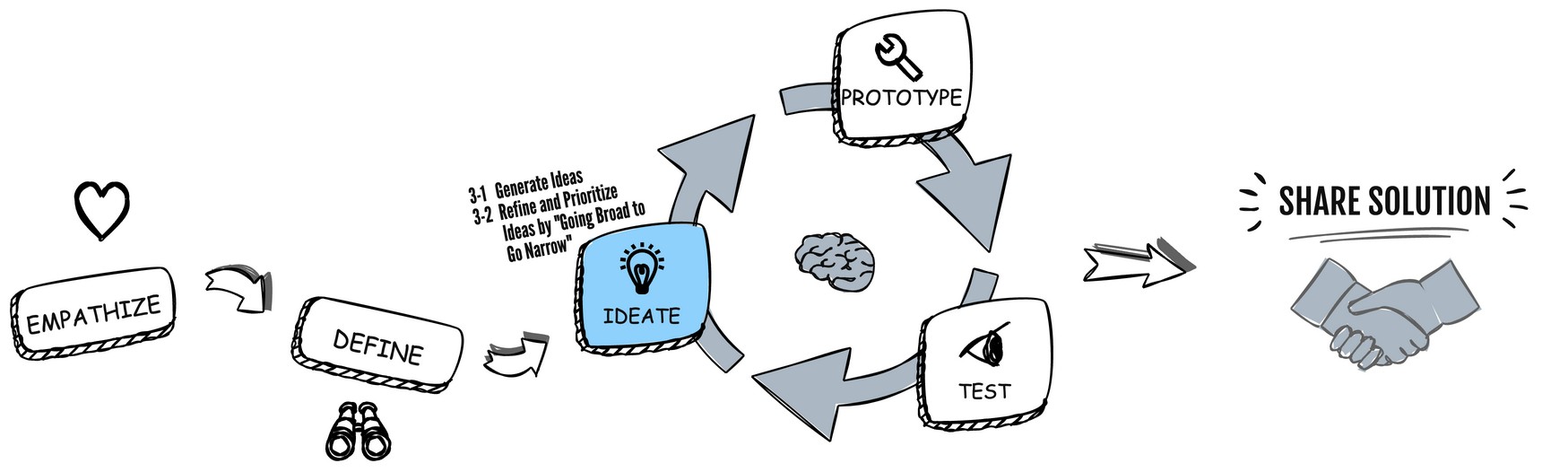
Stage 3 – Ideate
What is it?
Ideate is the third stage of the design thinking process. This is where creative energy truly starts flowing. After you’ve empathized with your customers and users and defined the problem and ideal state, the ideation offers a platform for generating innovative solutions. This is not just about coming up with a huge volume of ideas. It’s about finding diverse, out-of-the-box concepts that can provide novel solutions to the defined problem. In this stage, every idea, no matter how radical it seems, is embraced and considered.
Why do it?
The ideate stage is important because it helps you to break out of conventional thinking and generate a wide range of potential solutions. By generating a large number of ideas, you increase the likelihood of finding a truly innovative and effective solution.
What are the inputs?
The inputs for the ideate stage include:
- The problem and ideal state statements defined in the previous stage
- The insights and empathy gained from the EMPATHIZE stage
- Data and analytics related to the problem you’re trying to solve
- Feedback and complaints from users related to the problem (voice of the customer [VoC])
What are the outcomes?
The outcomes of the ideate stage include:
- A diverse range of ideas that represent different perspectives and approaches
- A set of prioritized ideas that are most promising and feasible
What are the tools and techniques to use?
Some of the most common tools and techniques used in the ideate stage include:
- Brainstorming: This involves generating a large number of ideas in a short amount of time, without judgment or evaluation.
- TRIZ: This is a systematic problem-solving methodology that aims to create innovative solutions by identifying universal principles of problem-solving.
- 2×2 Matrix: A highly effective tool used for prioritizing tasks or ideas. By evaluating each item on two key parameters and placing them on a four-quadrant matrix, it simplifies decision-making and assists in identifying which tasks or ideas should be prioritized based on their respective urgency and impact.
- SCAMPER: This is a mnemonic that stands for Substitute, Combine, Adapt, Modify, Put to another use, Eliminate, and Rearrange. It’s a structured approach to idea generation that encourages you to think about how you can modify and combine existing ideas to create something new.
- Mind mapping: This is a visual tool that helps you to organize and explore different ideas and connections between them.
- Analogies: This involves drawing parallels between the problem you’re trying to solve and unrelated concepts or industries, to generate new ideas and perspectives.
Brainstorming
Brainstorming serves as a critical tool during the ideation stage, facilitating a free-flowing exchange of ideas where quantity prevails quality (that’s only in the beginning as we are going broad to narrow later). The objective here is to stimulate creative thinking and generate as many ideas as possible (go broad), no matter how unfeasible, not practical or stupid they may seem initially. The energy of this exercise lies in its inclusivity and the synergy of diverse perspectives. Therefore, judgment is suspended and every idea is welcome. As ideas bounce off one another, new and innovative concepts often emerge. Post-it notes, whiteboards, or digital collaboration tools often aid this process as visual and tangible repositories of ideas. Brainstorming, if done right, is not just a process of idea generation. It also creates an environment of collaboration, creativity, and encourages a shift from conventional ways of thinking to new, unexplored territories. Here’re the instructions and tips for brainstorming sessions:
Understand the Challenge: Before you begin brainstorming, make sure you fully understand the problem statement or design challenge. What are you trying to achieve? Who are you designing for? Keep these questions in mind throughout the ideation process.
Brainstorm: Now, it’s time to let the ideas flow. There are no bad ideas at this stage; the goal is to generate as many as possible. Encourage everyone to share their thoughts, no matter how far-fetched they may seem. Remember, the focus is on quantity over quality.
No Judgment: Reinforce the principle of non-judgement during this stage. Every idea is valid and welcome.Negative feedback or criticism is not allowed. This ensures people feel safe and encouraged to contribute.
Build on Others’ Ideas: Collaborate actively. If someone else’s idea sparks a thought, build on it. Synergistic thinking often leads to the most innovative solutions.
Cluster related ideas: As a team, start grouping the sticky notes based on their similarities or relationships. Encourage open discussion and collaboration among team members during this process.The goal is to create clusters of related items, which will represent similar ideas.
Label the clusters: Once you’ve formed the clusters, create a label or theme for each group that summarizes its core idea or insight.
Timeboxing: Set a limit for your brainstorming session. This encourages focus and productivity. You might be surprised at what can be achieved in a short, intense brainstorming session!
Wrap-Up: At the end of the session, have a quick look at all the ideas generated. You don’t have to discuss or evaluate them now, but it’s good to give everyone a sense of the breadth of thinking that took place.
Here’s how the brainstorming session outcome would look like for the SpineAlign case study we started in Part 2. This example is also available in my Design Thinking Toolkit and Guidance in Miro.

TRIZ
TRIZ provides a systematic approach to generate and evaluate creative ideas, using a set of tools and techniques that leverage patterns of innovation and contradictions. TRIZ patterns are similar to the concept of design patterns in Software Engineering, but applicable in business and engineering disciplines. Therefore, by using TRIZ, which I’ve recently introduced and presented at the DeveloperWeek conference, ideation becomes even more dynamic and structured, guiding us toward more efficient problem-solving paths. Furthermore, TRIZ is an effective method to stimulate ideas during “cold start” situations, when brainstorming seems stagnant. By providing a systematic thought process, inventive principles and Contradiction Matrix, TRIZ can spark innovative solutions and breathe fresh life into the creative process.
Take for example our hypothetical scenario where our goal is to provide posture alerts to users, but without hampering the seamlessness of their user experience. Here, we encounter a contradiction. On one hand, we are striving to enhance posture accuracy, but on the other, we face the risk of degrading the user experience due to potential distractions. This delicate balancing act between improving one parameter without worsening the other is at the core of our challenge.
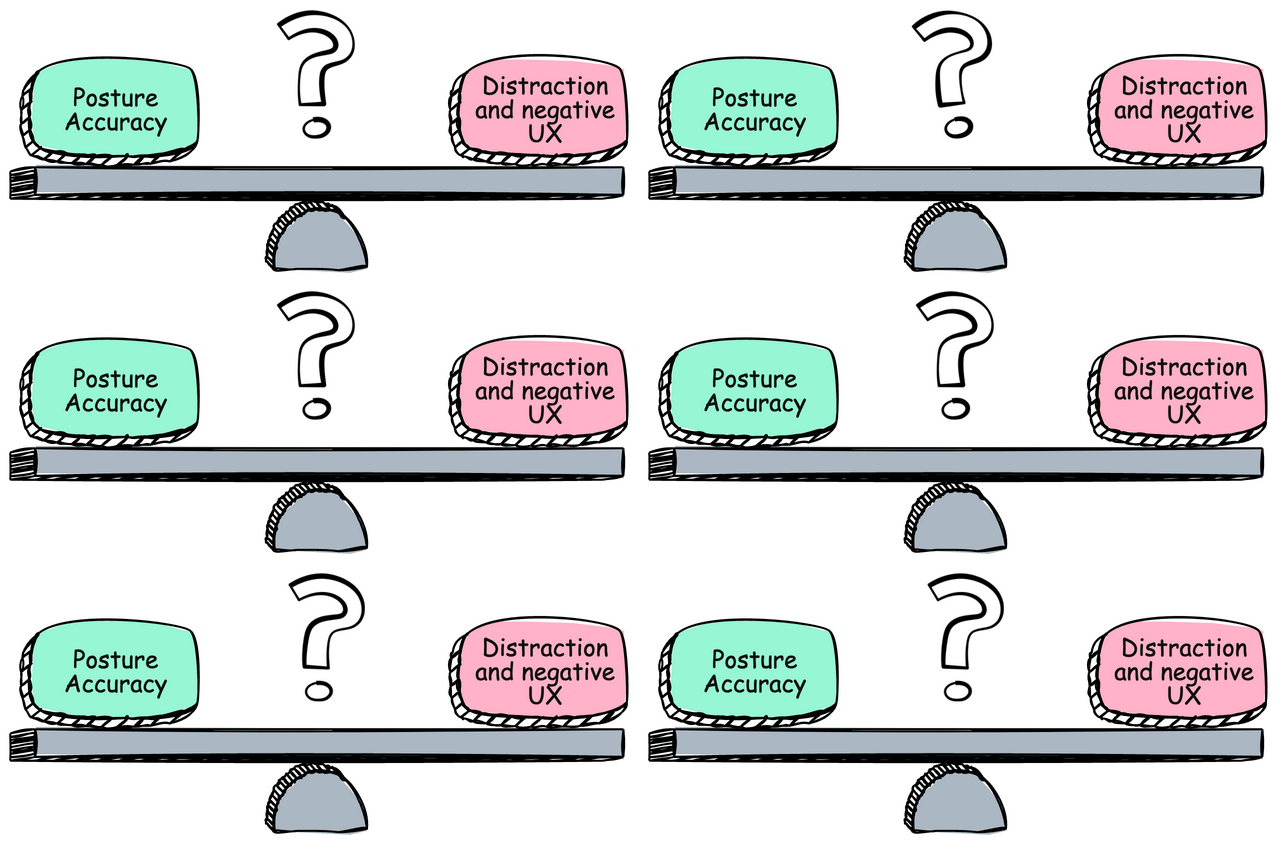
This can be generalized to a contradiction between generic system parameters (attributes, qualities or characteristics) Accuracy which we want to improve and Harmful Effects Generated by System which becomes worse as we introduce or improve accuracy. Then we can lookup for this pair in the TRIZ contradiction matrix.

Drawing from one of the core principles of inventive systems known as Dynamization, we can find inspiration in the following examples:
- Allow customers to make customizations in product or system
- Leveraging this idea we can let customers choose between various alert types such as sound, visual or haptic.
- Dynamize towards “intelligent” systems, able to make decisions autonomously
- For instance we can introduce an intelligent capability that learns our behavior and decides where, when and how to alert us.
- Dynamic processed, policies or rules based on certain conditions
- We can come up with rules such that if customers at work or at certain location and/or during specific hours, then don’t disturb them (or alert them in case of the bad posture).
Multiple principles of inventive systems can be combined to create even more interesting ideas.
To sum up, TRIZ serves as an invaluable tool that can enrich both brainstorming and ideation stages, although it requires a steep learning curve to fully harness its potential. I’ve detailed some aspects of TRIZ in my previous post and plan to delve deeper into this subject in future write-ups.
2×2 Matrix
Now that we went broad and generated many ideas, let’s see how we can go narrow and select only those that we think are the most impactful and less complex and risky (although it’s ok to take educated risks when appropriate).

Once we are done, we have a narrow list of the most impactful and low complexity ideas to focus on.
That’s all for this time. In the next part, I’ll dive into the details of the prototype stage, unpack the elusive concept of “leap of faith” assumptions and the process of experimentation. Until then, keep innovating!
 Michael Kalika's Blog
2 responses to “Introduction to Design Thinking – Part 3”
Very interesting!!
Thank you! Glad you found it interesting.