
This is a continuation of the Introduction to Design Thinking post series:
- Part 1 explains what Design Thinking is and why you should care. It also delves into the EMPATHIZE stage with a focus on customer research
- Part 2 describes the DEFINE stage and introduces concepts of customer pain, problem statement and ideal state.
- Part 3 describes the IDEATE stage and delves into ideation, brainstorming, idea prioritization and TRIZ.
Stage 4 – Prototype
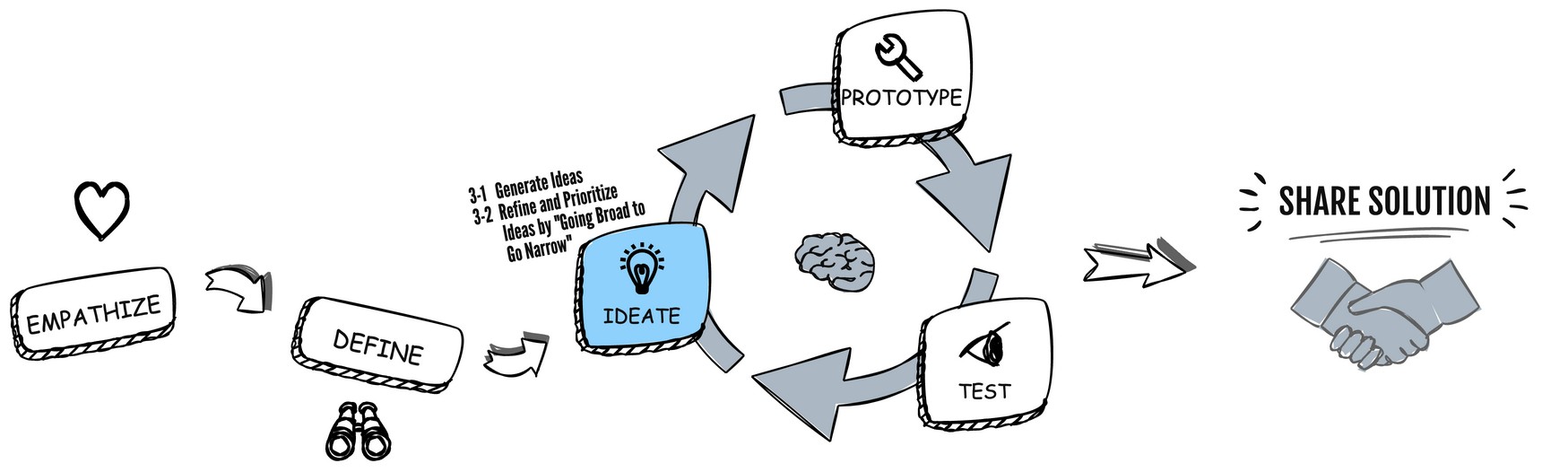
What is it?
The PROTOTYPE stage is the 4th stage of the design thinking process, and it’s all about proving assumptions and creating rough and low-fidelity models of the most promising solutions generated in the previous IDEATE stage. In this stage, our goal is to create something tangible that can be tested and evaluated by customers and users.
Why do it?
The PROTOTYPE stage is important because it allows you to identify and test your ideas and assumptions in a low-risk and low-cost way. By creating prototypes, you can quickly and efficiently gather feedback from customers and users, and then refine your solutions before investing significant time and resources in development.
What are the inputs?
The inputs for the prototype stage include:
- The most promising ideas generated in the ideate stage
- The insights and feedback gained from the empathize and define stages
- Data and analytics related to the problem you’re trying to solve
- Principles and criteria established in the define stage
What are the outcomes?
The outcomes of the prototype stage include:
- Leap of Faith Assumptions (LOFAs)
- A tangible representation of the solution that can be tested and evaluated – experiments
What are the tools and techniques to use?
Some of the most common tools and techniques used in the prototype stage include:
Leap of Faith Assumptions: A “leap of faith”assumption (or LOFA) is a fundamental hypothesis that needs to be true for a new idea, product, architecture or strategy to succeed.
Paper prototyping: This involves creating rough sketches and models of the solution using paper and other low-fidelity materials.
Digital prototyping: This involves using digital tools such as wireframing software, mockup tools, or prototyping software to create interactive and functional prototypes.
Role-playing: This involves acting out scenarios and interactions with the prototype to simulate how users might interact with the solution.
Dry Runs: A “dry run” is like a practice round. It’s when you try out your plan or solution without any real risk, just to see how well it works and if there are any problems you need to fix before you do it for real. You can think of it like a dress rehearsal for a play, or a test drive for a car. It’s all about making sure everything runs smoothly before the actual performance or use.
Simulations: A “simulation” is like a pretend scenario. It’s a way to mimic or recreate real-world situations or processes in a controlled environment. For example, pilots use flight simulators to practice flying without leaving the ground, and video games can simulate everything from running a farm to driving a race car. Simulations let you see what could happen in different situations, so you can be better prepared for the real thing. They’re used in many fields like science, engineering, and training to learn, test ideas, or predict what might happen. Some of the tools for simulations are iThink, AnyLogic, Simulink and open source tools like SimPy, Salabim and others.
User testing: This involves testing the prototype with real users to gather feedback and insights.
Leap of Faith Assumptions
A “Leap of Faith Assumption” (or LOFA) is a foundational hypothesis that needs to be true for the proposed solution, idea, model or strategy to work. This assumption is called a “leap of faith” because it is usually based on an educated guess rather than hard data or established facts.
This type of assumption often involves taking a risk or venturing into unknown territory, because there’s no certainty the assumption will prove correct. It’s a leap into the unknown with the faith that the hypothesis will hold true.
It is highly important to test the LOFAs through experiments and prototypes as early as possible to mitigate the risk associated with them. If these assumptions prove incorrect, the original idea may need significant adjustments, or might even be unviable.
Examples of Leap of Faith Assumption
Ridesharing Apps: When ridesharing apps like Uber and Lyft first started, their leap of faith assumption was that people would be comfortable using their personal cars to transport strangers, or conversely, riding in a stranger’s car instead of a licensed taxi. If this assumption had proven incorrect, the entire business model of these companies would have been unworkable.
Online Shopping: E-commerce giants like Amazon and eBay had the leap of faith assumption that people would trust buying goods online without physically seeing or touching them. They invested in secure payment systems and reliable delivery methods to test this assumption. If people had not been willing to trust online shopping, these companies would not have succeeded.
Digital Streaming Services: Companies like Netflix and Spotify made a significant leap of faith assumption that consumers would be willing to shift from ownership (buying DVDs, CDs) to access streaming content. Their success depended heavily on this shift in consumer behavior.
Airbnb: Airbnb’s founders proposed the leap of faith assumption that people would be willing to let strangers into their homes and be comfortable staying in strangers’ homes in cities around the world. This diverged significantly from traditional lodging options like hotels. They also assumed that homeowners would be interested in monetizing their empty spaces. Airbnb’s entire business model would have collapsed had these assumptions been wrong.
To start with LOFA the first step is to identify them. Here’s how the LOFAs would look like for the SpineAlign case study we started in Part 2. This example is also available in my Design Thinking Toolkit and Guidance in Miro.

Next, we go narrow by evaluating the LOFAs and prioritizing them based on their importance to success and their validation status. Evaluating and prioritizing LOFAs is critical for several reasons:
- It helps in effective resource allocation, allowing businesses to concentrate on testing the most vital assumptions.
- It’s key for risk management. Assumptions crucial for success but not yet validated carry significant risk, and early testing can help mitigate this.
- It enables the development of robust business strategies that focus on the most impactful factors.

It is important to note that this strategy doesn’t aim to eliminate all uncertainties, but to manage and reduce them effectively.
Now that we identified crucial to success and not proven true yet assumption let’s define a LOFA statement:

Having a LOFA statement defined, we are ready to define experiments and prototypes.
Experiments
Experiments are structured tests designed to validate or invalidate a hypothesis or a set of assumptions, particularly the “Leap of Faith Assumptions” (LOFAs). By testing assumptions and hypotheses early and often, engineers, architects, product managers and entrepreneurs can avoid costly mistakes and pivot more efficiently if necessary. Therefore, experiments are essential tools for gathering evidence, minimizing risk, and learning quickly.
How to start with experiments?
First of all, have everyone review the LOFA and share their experiment ideas one at a time. Look for patterns and similarities among the ideas. Group related sticky notes together.
Identify what are the pros and cons? How feasible are they? How directly do they test your LOFA?

Remember, that the goal of this stage is to prove the idea and LOFA and not implement a full solution. Here’s a compilation of different idea validation patterns that you might find useful.
Now let’s use 2×2 matrix to prioritize experiments:

Next, let’s define the experiment for the High Learning Potential and Low Investment / Low Risk experiment:

That’s all for today. We are ready for running experiments and proof ideas and assumptions. In the next and final part, I’ll share about the TEST stage. Until then, keep innovating!
 Michael Kalika's Blog